Holi 2026: Date, Muhurat, History, Significance, and Traditional Foods

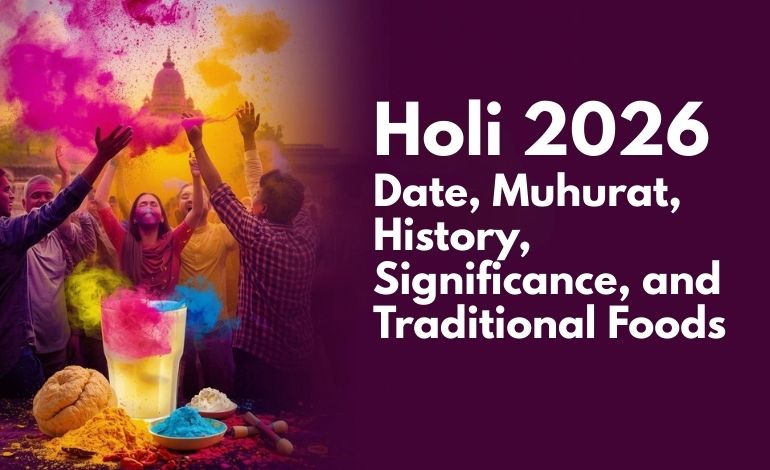
Holi is one of India’s most vibrant and joyous festivals – a time when people come together to celebrate the arrival of spring, the victory of good over evil, and the joy of love and friendship. Known popularly as the “Festival of Colours,” Holi is marked by colourful celebrations, festive foods, and age-old traditions that unite families and communities across the country.
Holi 2026 Date & Muhurat (Timing)
In 2026, Holi will be celebrated over two main days:
- Holika Dahan (Chhoti Holi): Tuesday, 3 March 2026 — bonfire night to symbolise the destruction of evil.
- Rangwali Holi (Main Festival of Colours): Wednesday, 4 March 2026 — the day when people play with colours, water, music, and dance.
According to Drik Panchang, the auspicious muhurat for Holika Dahan in many places falls in the evening of 3 March, around 06:22 PM to 08:50 PM (subject to local Panchang timings).
Because Holi follows the Hindu lunar calendar (Phalguna Purnima), the exact date changes every year, always landing around full moon night in late February or early March.
History & Mythological Story Behind Holi
Holi’s roots lie deep in Hindu mythology and ancient traditions that carry powerful symbolism:
The Legend of Holika and Prahlad
The most popular story associated with Holi is about the demon king Hiranyakashipu, his son Prahlad, and his sister Holika.
Hiranyakashipu wanted to be worshipped as a god, but his son Prahlad remained devoted to Lord Vishnu. Angered by Prahlad’s faith, Holika — who was blessed with immunity from fire — sat with Prahlad in a blazing fire to kill him. Instead, Holika was consumed by the flames while Prahlad was protected by divine grace. This event is commemorated as Holika Dahan, symbolising the victory of righteousness over evil.
Krishna and Radha
Another tradition links Holi with the love of Lord Krishna and Radha. It is said that young Krishna, who had a dark complexion, playfully applied colour to Radha’s face so she would look like him — a gesture that evolved into the colour-throwing celebrations we see today.
Significance of Holi
Holi is more than a fun festival – it has deep cultural and spiritual meaning:
- Celebration of Spring: Holi heralds the arrival of spring, a season of growth, renewal and brightness.
- Triumph of Good Over Evil: The bonfire of Holika Dahan symbolises burning away negativity and starting afresh.
- Social Harmony: Holi breaks social barriers – people of all ages and backgrounds throw colours, hug, forgive, and renew relationships.
- Cultural Expression: Music, dance, folk traditions (like Lathmar Holi in Barsana and Braj Holi in Mathura/Vrindavan) add rich cultural layers to how Holi is celebrated across India.
Traditional Foods & Drinks of Holi
Food in Holi celebrations is an essential part of the festivities. From sweet treats to savoury snacks, each dish adds flavour to the colourful day:
Gujiya
A sweet, deep-fried dumpling filled with khoya (milk solids), nuts, and cardamom — gujiya is a quintessential Holi dessert enjoyed all over India.
Thandai
A refreshing milk drink blended with almonds, cardamom, saffron, pistachios and sometimes bhang (in some regions) that cools you down after hours in colour and sun.
Malpua & Rabri
Sweet pancakes served with thickened condensed milk (rabri) — another favourite during Holi gatherings.
Savoury Snacks
Items like papri chaat, kachori, samosas, and dahi-vada are common festive offerings, giving balance to the sweet palate.
How Holi Is Celebrated Across India
Holi varies from place to place:
- Mathura & Vrindavan: Holi here stretches over weeks with unique customs like Braj Holi and Phulera Dooj.
- Barsana & Nandgaon: Famous for Lathmar Holi, where women playfully chase men with sticks.
- Delhi & Major Cities: Huge gatherings in parks, community events, colour runs, music and cultural shows mark modern celebrations.
Final Thoughts
Holi is one of India’s most colourful and culturally rich festivals. In 2026, with Holika Dahan on 3 March and Rangwali Holi on 4 March, families and communities will come together to celebrate joy, love, and the spirit of togetherness. From age-old traditions to delicious seasonal foods, Holi captures the essence of spring and the joy of life.